
Blog
Choosing the Right Disposable Gloves for Caregiving and Home Care.

Choosing the Right Disposable Gloves for Caregiving and Home Care.*
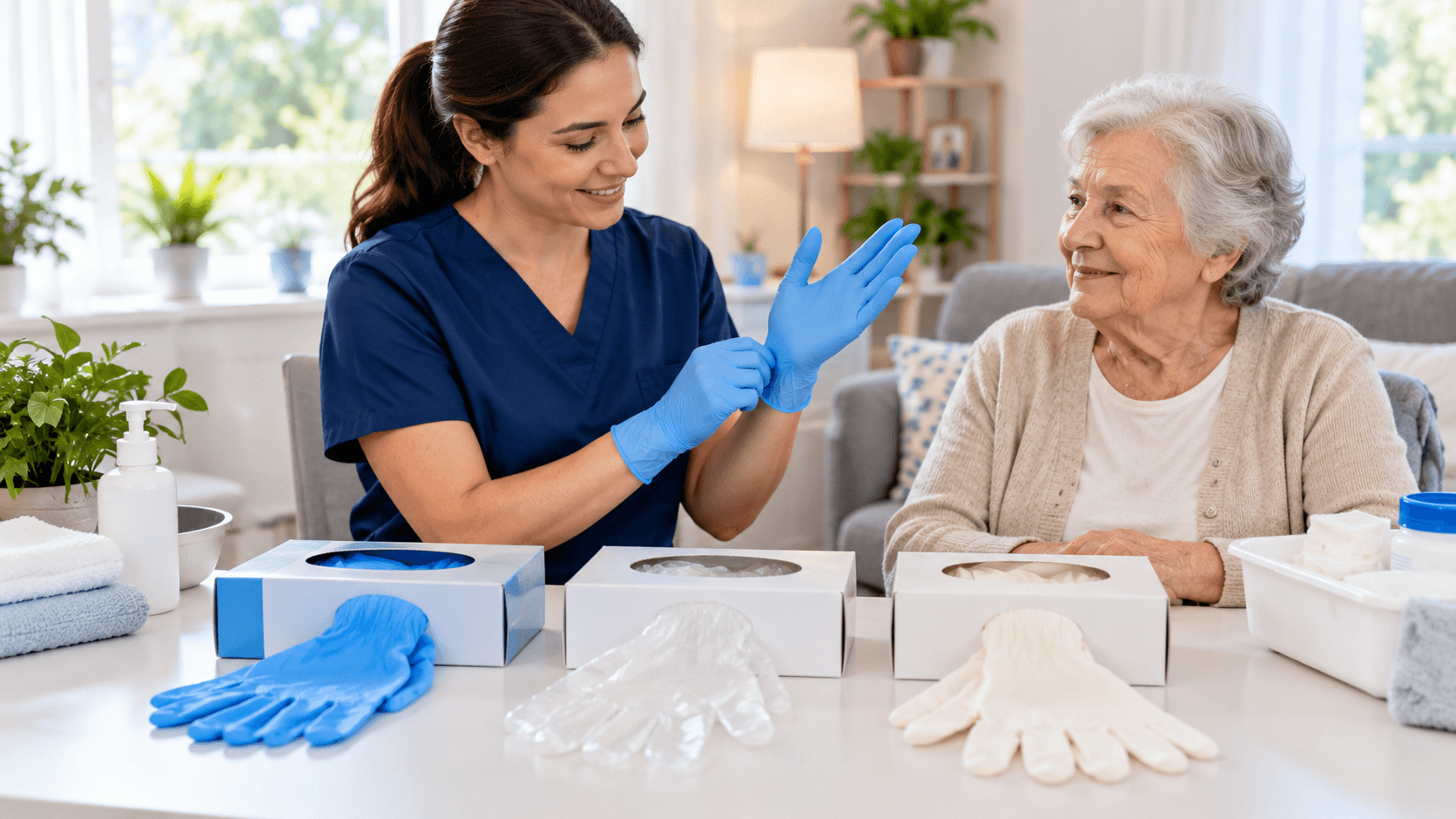
Choosing the right disposable gloves for home care is important for caregivers, seniors, patients, and family members who manage daily hygiene tasks. Gloves help reduce direct contact with urine, stool, wound drainage, body fluids, cleaning products, used supplies, and other materials during care. They are commonly used during diaper changes, wound care, catheter care, ostomy care, bathing routines, toileting support, and general cleaning.
The right disposable glove should fit well, feel comfortable, allow good hand movement, and provide the level of protection needed for the task. Not every glove is the same. Some gloves are nitrile, some are vinyl, and some are latex. Some have textured fingertips for better grip, while others are smooth for light-duty tasks. Some gloves are chemo tested or fentanyl tested, while others are not rated for those uses. For home care, caregivers should choose gloves based on material, size, texture, sensitivity, and the type of care being provided.
Nitrile gloves are a common choice for home care because they are latex-free, durable, and suitable for many hygiene and patient-care tasks. For caregivers who need dependable daily hand protection, the Exam Glove McKesson Confiderm 3.0 Large NonSterile Nitrile Standard Cuff Length Textured Fingertips Blue Chemo Tested Fentanyl Tested can be useful. Textured fingertips can help improve grip when handling wipes, bottles, dressings, underpads, and other care supplies.
For users who want a nitrile glove with a slightly different feel, the McKesson Confiderm 3.5C Nitrile Gloves can support daily care routines. These gloves are described as powder-free and latex-free, with textured fingertips and a beaded cuff. They can be helpful for caregivers who need comfort, protection, and better control during regular home-care tasks.
For smaller hands, glove size is very important. Gloves that are too large can slip, reduce grip, and make care tasks harder. Gloves that are too tight can feel uncomfortable and may tear more easily. The Exam Glove McKesson Confiderm 3.0 Small NonSterile Nitrile Standard Cuff Length Textured Fingertips Blue Chemo Tested Fentanyl Tested can be useful for caregivers who need a smaller nitrile glove with secure coverage.
Another option for smaller hands is the Exam Glove McKesson Confiderm 3.8 Small NonSterile Nitrile Standard Cuff Length Textured Fingertips Blue Not Rated. This can be suitable for general daily care tasks when a small nitrile glove is preferred. A proper fit can help caregivers work more confidently during cleaning, changing, and personal-care routines.
For extra-small sizing, the Exam Glove McKesson Confiderm 4.5C X-Small NonSterile Nitrile Standard Cuff Length Textured Fingertips Blue Chemo Tested can support users who need a closer fit. X-small gloves can be helpful for caregivers with smaller hands because they may improve control and reduce loose material around the fingers.
For caregivers who want a fully textured nitrile glove, the Exam Glove McKesson Confiderm LDC Large NonSterile Nitrile Standard Cuff Length Fully Textured Black Chemo Tested Fentanyl Tested can be useful. Fully textured gloves may help when handling bottles, tubing, dressings, adhesive products, or other supplies where grip is important.
Some caregivers may prefer colored nitrile gloves for easy identification or personal preference. The Exam Glove McKesson Pink Nitrile Large NonSterile Nitrile Standard Cuff Length Textured Fingertips Pink Not Rated can be used for routine care when a nitrile option is needed. Since this product is not rated for some specialized uses, caregivers should choose it for appropriate general tasks and follow product labeling.
Vinyl gloves can be useful for light-duty care and quick hygiene tasks. They are often used for short tasks such as basic cleaning, handling non-hazardous supplies, or simple personal-care routines. The Exam Glove McKesson X-Small NonSterile Vinyl Standard Cuff Length Smooth Clear Not Rated can be useful when a latex-free vinyl glove is preferred for lighter tasks.
For users who need a larger vinyl option, the Exam Glove McKesson X-Large NonSterile Stretch Vinyl Standard Cuff Length Smooth Ivory Not Rated can support light-duty home-care routines. Stretch vinyl gloves may feel more flexible than standard vinyl gloves, but they should still be chosen based on the task and protection level needed.
Latex gloves may feel flexible and comfortable for some users, but they are not suitable for people with latex sensitivity or latex allergy. The McKesson Confiderm DCL Latex Exam Gloves, Powder Free can be considered only when latex is appropriate for the user and patient. Caregivers should avoid latex gloves if anyone in the care environment has a known latex allergy.
Another latex option is the Exam Glove McKesson Confiderm Medium NonSterile Latex Standard Cuff Length Smooth Ivory Not Rated. Because latex can cause allergic reactions in some people, caregivers should always check product warnings and choose a latex-free option when needed.
Disposable gloves are especially useful during incontinence care. When changing adult diapers, pull-ups, pads, or underpads, caregivers may come into contact with urine, stool, wipes, skin cleanser, and soiled products. Gloves help keep hands cleaner and make the process more hygienic. After removing a wet or soiled product, caregivers should remove gloves carefully, dispose of them properly, wash hands, and use a fresh pair if continuing with clean care steps.
Gloves are also important during wound care. Caregivers may need to remove old dressings, clean around the wound, apply new dressings, handle saline, or dispose of used supplies. Gloves can reduce direct contact with wound drainage and used dressings. However, gloves do not replace proper handwashing. Hands should be cleaned before putting gloves on and after removing them.
For catheter care, gloves help caregivers handle drainage bags, tubing, external catheters, specimen containers, and cleaning supplies more safely. Catheter care needs careful hygiene because poor technique may increase infection risk. Caregivers should follow the healthcare provider’s instructions, avoid touching clean catheter parts with contaminated gloves, and change gloves between dirty and clean tasks.
For ostomy care, gloves can make pouch changes cleaner and easier. Caregivers may need to empty pouches, clean peristomal skin, remove adhesive products, apply barrier rings, or handle used ostomy supplies. Gloves help reduce direct contact with output and adhesive residue. After cleaning and disposal, caregivers should use fresh gloves if they need to apply a new pouching system.
Texture is another factor to consider. Textured fingertips or fully textured gloves can help improve grip when hands may become wet or when caregivers are handling small items. This can be useful for opening product packaging, holding cleansing wipes, managing catheter tubing, applying wound dressings, or using adhesive remover wipes. Smooth gloves may be enough for simple tasks, but textured gloves can provide better control during more detailed care.
Powder-free gloves are usually preferred for home care because glove powder can be messy and may irritate skin for some users. Many nitrile, vinyl, and latex glove options are powder-free. Caregivers should also choose gloves that feel comfortable for the length of the task. If gloves cause itching, redness, or discomfort, the user may need a different material or size.
A simple glove routine can improve daily care. First, wash and dry hands before putting gloves on. Next, choose the correct size and material for the task. Use gloves only once, and do not wash or reuse disposable gloves. Remove gloves carefully by turning them inside out while taking them off. Throw used gloves into the trash and wash hands again.
Caregivers should keep different glove sizes available if more than one person provides care. A glove that fits one caregiver may not fit another. Keeping small, medium, large, or extra-large sizes ready can make care faster and more comfortable. Gloves should be stored in a clean, dry place away from heat, moisture, and direct sunlight.
The best disposable gloves for home care depend on the task, the caregiver’s hand size, the patient’s sensitivity, and the level of protection needed. Nitrile gloves are a strong latex-free choice for many daily care tasks. Vinyl gloves can be useful for light-duty care. Latex gloves may work for some users but should be avoided when latex allergy is a concern. Textured gloves can help improve grip, while smooth gloves may be enough for simple cleaning tasks.
Products like the Exam Glove McKesson Confiderm 3.0 Large NonSterile Nitrile Standard Cuff Length Textured Fingertips Blue Chemo Tested Fentanyl Tested, McKesson Confiderm 3.5C Nitrile Gloves, Exam Glove McKesson Confiderm 3.0 Small NonSterile Nitrile Standard Cuff Length Textured Fingertips Blue Chemo Tested Fentanyl Tested, Exam Glove McKesson Confiderm 3.8 Small NonSterile Nitrile Standard Cuff Length Textured Fingertips Blue Not Rated, Exam Glove McKesson Confiderm 4.5C X-Small NonSterile Nitrile Standard Cuff Length Textured Fingertips Blue Chemo Tested, Exam Glove McKesson Confiderm LDC Large NonSterile Nitrile Standard Cuff Length Fully Textured Black Chemo Tested Fentanyl Tested, Exam Glove McKesson Pink Nitrile Large NonSterile Nitrile Standard Cuff Length Textured Fingertips Pink Not Rated, Exam Glove McKesson X-Small NonSterile Vinyl Standard Cuff Length Smooth Clear Not Rated, Exam Glove McKesson X-Large NonSterile Stretch Vinyl Standard Cuff Length Smooth Ivory Not Rated, McKesson Confiderm DCL Latex Exam Gloves, Powder Free, and Exam Glove McKesson Confiderm Medium NonSterile Latex Standard Cuff Length Smooth Ivory Not Rated can help caregivers choose the right glove for daily home care. Explore disposable gloves, nitrile gloves, vinyl gloves, latex gloves, and caregiver hygiene supplies at Zushki to build a cleaner and more prepared care routine.
*Medical Disclaimer ( Important) :
The information provided in this article is for general educational and informational purposes only and is not intended as medical advice, diagnosis, or treatment. Always seek the advice of your physician or another qualified healthcare provider with any questions you may have regarding a medical condition or before using any products, medication, medical device, or healthcare product. Never disregard professional medical advice or delay seeking it because of something you have read on this website. Products offered by Zushki.com are intended to be used in accordance with their labeling and the manufacturer’s instructions. Individual needs and medical conditions vary, and not all products are appropriate for every person. If you believe you are experiencing a medical emergency, call 911 or contact your local emergency services immediately.